
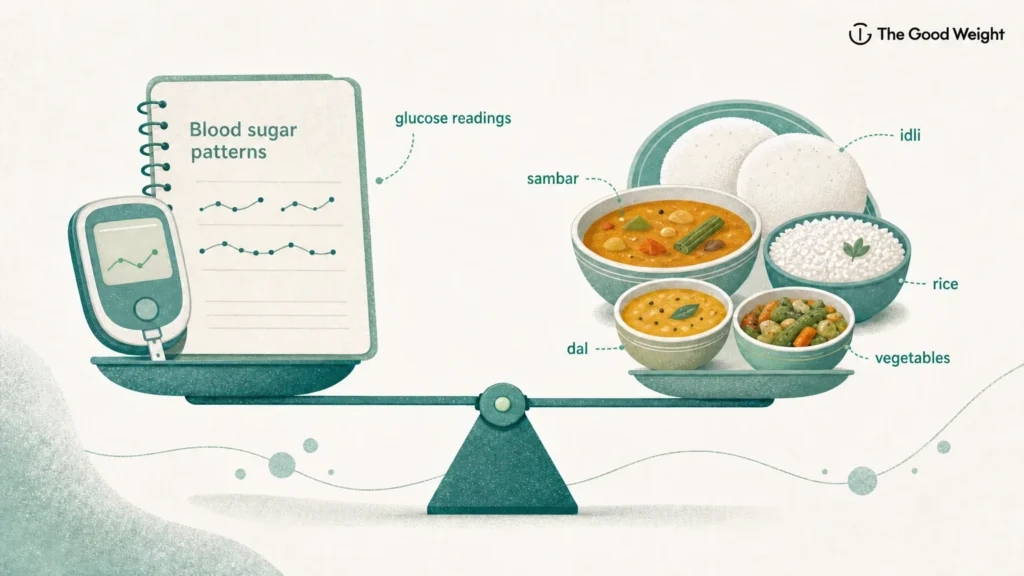
You have changed your breakfast, started walking and reduced portions, yet your glucose readings still vary. It is tempting to blame yesterday’s rice or make another restriction immediately. But controlling blood glucose levels safely means understanding patterns – not treating every number as a problem to fix yourself.
A useful tracking routine connects readings with meals, movement, sleep, illness and prescribed treatment. This tutorial shows how to build that record, compare familiar Indian meals and recognise when to seek help. The goal is better information for shared decisions, not independent medication changes.
1. Understand what glucose tracking can tell you
During weight loss, glucose tracking can help you notice whether readings repeatedly differ after certain meals, on less-active days or when you are unwell. It cannot reliably explain the cause of every change. Food, activity, stress and illness can all affect glucose, while individual glucose goals and monitoring plans need personalisation.
A single reading is a snapshot, not a verdict on your meal or progress. Even two apparently similar breakfasts may differ in portion, preparation, timing or the previous night’s sleep. Look for recurring patterns under reasonably comparable conditions rather than labelling one food “bad”.
Home readings also do not replace clinical assessment or laboratory testing for diabetes. Ask your clinician whether tracking is useful for you, which device to use and when to check. If you take insulin or another medicine that can cause hypoglycaemia, discuss dietary and activity changes before starting: hypoglycaemia risk should inform treatment and monitoring decisions.
2. Build a simple log with context
Use a notebook, phone note or device report – whichever you can maintain comfortably. Follow your agreed testing schedule rather than adding frequent checks out of anxiety. Record enough context to make each reading understandable without turning eating into a constant calculation.
Copy this template and adapt it with your care team:
| What to record | Fill-in prompt |
|---|---|
| Reading | Date: ___ Time: ___ Glucose: ___ Units: ___ Device: ___ |
| Relationship to food | Before eating / ___ after the first bite / other: ___ |
| Meal timing and composition | Meal start: ___ Foods, drinks and approximate portions: ___ |
| Activity | Type, duration and timing before or after eating: ___ |
| Sleep | Approximate duration and quality: ___ |
| Stress | Usual / higher than usual; relevant context: ___ |
| Illness | Fever, infection, vomiting, reduced appetite or other changes: ___ |
| Medication | Name, prescribed dose and actual time taken; any missed dose: ___ |
| Symptoms | What happened, when, and what action you took: ___ |
Use the same units consistently and note whether readings come from a finger-prick meter or sensor. Ask your team how to check an unexpected result and what to do if symptoms do not match the device. Do not delay urgent treatment or care simply to complete the log.
3. Compare familiar Indian meals without banning foods
The following examples illustrate questions to explore, not prescribed meals or predicted glucose results. Your response may differ from someone else’s, even when the dishes look similar. Agree on any changes with your clinician or dietitian, especially if smaller meals could affect medication safety.
Breakfast example: idli, sambar and chutney
Suppose idli with sambar and chutney is your usual breakfast. Record the number and approximate size of the idlis, the amount of sambar, any sweetened drink and the meal’s timing. Also note whether breakfast followed poor sleep, a rushed commute or an unusually long gap without food.
Your dietitian might discuss adjusting the portion, including a suitable protein source or increasing vegetables within the meal. Keep other conditions reasonably similar when comparing an agreed adjustment, rather than changing everything at once. The purpose is to find a satisfying breakfast that fits your needs, not to prove that idli is universally suitable or unsuitable.
Rice-meal example: rice, dal, vegetables and curd
For lunch, record the cooked rice portion using a familiar household measure, alongside dal, vegetables, curd and any fish, egg, paneer or other protein. Include accompaniments and drinks rather than recording “rice lunch” alone. Meal timing and whether you sat, walked or exercised afterwards also belong in the log.
Discuss whether a different balance of rice, protein and vegetables would suit your appetite, glucose goals and nutritional needs. Ask whether gentle post-meal movement is appropriate for you; do not use strenuous exercise to “cancel out” a high reading. For meal-planning ideas to discuss at review, explore this doctor-led Indian diabetic meal chart.
4. Separate supportive changes from unsafe self-adjustments
Tracking should make decisions clearer, not encourage increasingly restrictive eating. Some adjustments can fit an existing care plan, while others require advance guidance. This distinction matters because meal planning, activity and medicines work together in diabetes management.
| Area | Discuss or follow within your agreed plan | Do not change independently |
|---|---|---|
| Meal balance | Suitable portions, protein, vegetables and regular meal timing | Skip meals or sharply restrict carbohydrates to chase a reading |
| Movement | Comfortable activity and a gradual increase suited to your health | Exercise through suspected low glucose or significant illness |
| Monitoring | Useful checking times, personal targets and device technique | Adopt someone else’s targets or repeatedly test without a purpose |
| Medication | Report patterns, missed doses, side effects and appetite changes | Reduce, stop, increase or retime glucose-lowering medication |
| Illness | Obtain written sick-day guidance and contact instructions | Improvise medication changes when eating or drinking less |
Only the prescribing clinician should authorise changes to glucose-lowering medication. This includes moving doses to match a new fasting schedule or stopping treatment because readings have improved. If weight loss or reduced appetite makes your current plan difficult, request a review rather than adjusting treatment yourself.
5. Know when to act promptly
Do not wait for a repeatable pattern when symptoms or readings suggest an immediate problem. Low glucose may cause shaking, sweating, hunger, dizziness or confusion; high glucose may cause thirst, frequent urination, blurred vision or fatigue. Symptoms can vary, so follow your written action plan and personal alert thresholds.
Safety checklist
- Possible low glucose: Follow your hypoglycaemia plan immediately. A glucose level below 70 mg/dL (3.9 mmol/L) is an alert threshold. For an adult who is awake and can swallow, guidance generally uses 15 g of fast-acting glucose, with reassessment after 15 minutes and repeat treatment if still low.
- Severe symptoms: Unconsciousness, seizure, severe confusion or inability to swallow require emergency help. Do not give food or drink by mouth; a trained person should use prescribed glucagon if available.
- Possible dangerous high glucose: Vomiting, abdominal pain, deep or rapid breathing, marked drowsiness or confusion need urgent assessment. Do not wait for another reading or attempt to exercise the glucose down.
- Repeated out-of-range readings: Contact your care team promptly for recurrent lows, readings beyond your agreed action limits, or illness that prevents eating or keeping fluids down. Follow existing sick-day and ketone-testing instructions where prescribed.
These instructions do not replace an individual emergency plan. Ask your team to write down whom to contact during and outside clinic hours. If severe symptoms develop or you cannot safely manage the situation, seek urgent care rather than waiting for a routine appointment.
6. Bring the right questions to your review
Bring your log or device download, current medication list with doses and timing, and any recent laboratory results. Include usual food patterns, symptoms, appetite changes and a weight trend if available – not just one weigh-in. Note practical barriers such as shift work, food costs or difficulty preparing separate meals.
Use these questions to guide the appointment:
- What patterns are meaningful, and what remains uncertain?
- What glucose targets and checking schedule suit me?
- Could my medicines make dietary changes or extra activity unsafe?
- How can we adapt my usual Indian meals without excessive restriction?
- What should I do during illness, low readings or persistently high readings?
- When should we review progress and reconsider the plan?
The most useful record explains what was happening around a reading. It helps your team build a personalised plan rather than asking you to chase isolated numbers. If glucose changes, symptoms or existing diabetes treatment make self-directed weight loss uncertain, book a clinician-led metabolic and nutrition review with The Good Weight in Chennai.
