
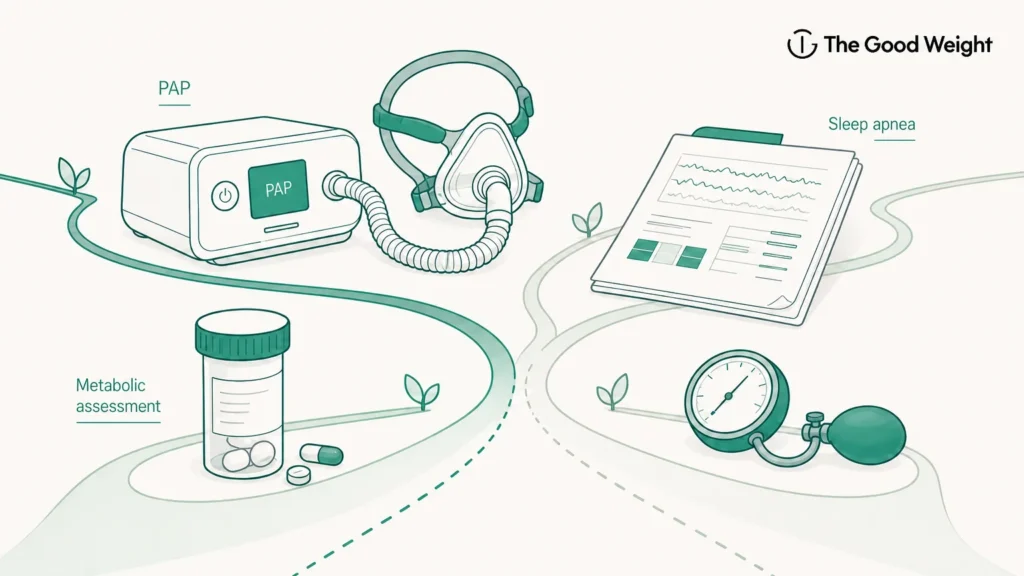
You may have been told that losing weight could help your snoring. But if you wake unrefreshed, struggle to stay alert during the day, or already use a sleep-apnea device, that advice leaves an important question unanswered: what should happen while weight is being addressed?
For adults in Chennai, the safest answer is usually coordinated care – not choosing between sleep treatment and weight treatment. Obstructive sleep apnea can require treatment now, while personalized weight care addresses a contributing factor over time. New medication options make this conversation increasingly relevant, but they do not remove the need for a sleep assessment.
Weight management can be an important part of sleep-apnea care when obesity contributes, but it does not replace assessment of severity, anatomy, symptoms, and existing treatment. This guide explains what a combined metabolic and sleep review should cover, which treatments may work together, and when symptoms need prompt attention.
What is the connection between sleep apnea and body weight?
Obstructive sleep apnea, or OSA, happens when the upper airway repeatedly narrows or closes during sleep. Breathing becomes reduced or temporarily stops, disrupting sleep and sometimes lowering oxygen levels. It differs from central sleep apnea, in which the brain’s signals controlling breathing are disrupted; the weight-focused approach discussed here mainly concerns OSA. A sleep assessment helps distinguish these conditions rather than assuming all snoring has the same explanation.
Body weight can influence how easily the airway stays open. Fat deposits around the tongue and upper airway may reduce available space, while abdominal fat can affect lung volumes and the forces that help support the airway. However, the relationship is not simply “higher weight equals sleep apnea.” The relationship between obesity and OSA involves several anatomical and physiological mechanisms.
A possible pathway – not an explanation for every patient:
Obesity in some patients
        ↓
More tissue around the airway and changes in breathing mechanics
        ↓
Greater tendency for the airway to narrow during sleep
        ↓
Obstructive breathing events, disrupted sleep and possible oxygen drops
Other factors also matter, including jaw structure, tongue position, enlarged tonsils, age, and how airway muscles behave during sleep. Someone without obesity can have clinically important OSA, while someone with obesity may not have it. The adult OSA evaluation guideline includes assessment of symptoms, airway anatomy, and objective sleep testing. This is why neither appearance nor body mass index can establish the diagnosis or determine the entire treatment plan.
The practical implication is reassuring: sleep apnea is not a personal failure, and weight is not the only possible treatment target. When obesity contributes, weight care may reduce the burden of disease and improve broader metabolic health. When anatomy or another mechanism is more important, a different intervention may take priority. Many patients need both approaches.
What should a metabolic and sleep review look at?
A useful consultation brings sleep findings and metabolic health into the same discussion. It should establish whether OSA is present, whether current treatment is effective, and whether weight management has a meaningful role. The clinical guideline on weight management in adults with OSA supports comprehensive lifestyle care and selected additional treatments. The review should therefore lead to a coordinated plan, not simply an instruction to lose weight.
Step 1: describe symptoms and their effect on daily life
Expect questions about snoring, witnessed breathing pauses, choking awakenings, morning headaches, and feeling unrefreshed. Explain whether you fall asleep unintentionally, struggle during meetings, or feel drowsy while commuting or driving. Sleep duration, shift work, alcohol use, and difficulty falling or staying asleep also deserve attention. A partner’s observations can be helpful, but symptoms alone cannot confirm OSA or measure its severity.
Step 2: review the sleep study, not just the diagnosis
Bring the full report if you have one, including its date and whether it was a home test or laboratory study. Clinicians review breathing-event frequency, oxygen levels, and whether events vary with sleeping position or sleep stage. The commonly used apnea-hypopnea index, or AHI, counts breathing disturbances per hour of sleep; adult OSA is generally categorized as mild at 5-14.9, moderate at 15-29.9, and severe at 30 or more, interpreted alongside the wider clinical picture. These severity categories and diagnostic considerations are described in the adult OSA guideline.
Step 3: assess blood pressure and metabolic risk
The review should include blood pressure, weight history, relevant measurements, and existing conditions such as diabetes. Depending on your history, the clinician may recommend glucose or HbA1c testing and other targeted investigations. The purpose is to identify health risks that could benefit from treatment – not to order a standard package of tests for everyone. Questions about health checks that matter in weight care can help you prepare for this discussion.
Step 4: review medicines and realistic daily routines
Bring a complete medication list, including sleeping tablets, pain medicines, supplements, and any weight-loss products. Some medicines can affect alertness, breathing, appetite, or body weight, so changes require individual review rather than abrupt stopping. Nutrition and movement discussions should account for work schedules, food preferences, physical limitations, and daytime fatigue. For a Chennai household, sustainable changes should work with familiar meals and daily responsibilities rather than depend on extreme dieting.
Step 5: check how well prescribed treatment is working
If you use positive airway pressure, bring your device details and usage report if available. Discuss mask leaks, nasal blockage, dry mouth, pressure discomfort, travel difficulties, and nights when you cannot use it. Device-recorded usage and residual breathing events can help the sleep team identify problems that the scale cannot explain. Persistent fatigue despite treatment deserves reassessment, not an automatic assumption that more weight loss is the answer.
Together, these steps help identify who should receive weight care alongside sleep treatment. A patient with OSA and obesity, especially with additional metabolic concerns, may benefit from a combined plan. A patient with marked sleepiness, substantial oxygen disturbance, or poorly controlled OSA needs timely sleep-treatment optimization regardless of weight goals. Someone without obesity may need a stronger focus on airway anatomy, sleep position, or other contributors.
Where does PAP treatment fit while weight is being addressed?
Do not stop or delay prescribed sleep-apnea treatment while trying to lose weight unless your treating clinician changes the plan. Positive airway pressure, or PAP, delivers pressurized air through a mask to help keep the airway open during sleep. Weight management works on a different timescale and cannot be assumed to control breathing events from tonight onward. The adult OSA guideline recommends PAP as an important treatment, particularly for moderate-to-severe disease.
A 2026 guideline states that weight loss may improve sleep-apnea severity and PAP adherence in patients with obesity and OSA who use PAP. “May improve” is important: it does not mean everyone will achieve remission or stop needing their device. Weight changes can also alter treatment requirements, making follow-up valuable. Any decision to reduce or withdraw therapy should follow clinical reassessment and, where appropriate, repeat sleep testing.
| Treatment pathway | When it may be prioritized | How it fits with weight care | Important limitation |
|---|---|---|---|
| PAP therapy | Often for moderate-to-severe OSA, significant symptoms, or a need for reliable control during sleep | Can continue while nutrition, movement, medication, or other weight treatment takes effect | Benefit depends on effective use; mask or pressure problems need troubleshooting |
| Custom oral appliance | Selected patients, often with mild-to-moderate OSA, or those unable to tolerate PAP | Can be used alongside weight management | Requires suitable dental assessment, fitting, and follow-up testing |
| Airway surgery or other specialist procedures | Selected anatomical obstruction or situations where other treatments are unsuitable or unsuccessful | May address an airway problem that weight care alone cannot resolve | Suitability and outcomes vary; reassessment remains necessary |
| Medically supervised weight care | OSA with overweight or obesity when clinically appropriate | Addresses a contributing factor and wider metabolic risk alongside airway treatment | Improvement takes time and does not guarantee resolution of OSA |
These options are not automatically competing alternatives. The adult OSA guideline describes PAP, oral appliances, surgery, and behavioral measures as components of individualized treatment. For example, a person who cannot tolerate a mask may need fitting adjustments, nasal-symptom treatment, or discussion of another airway therapy – not simply advice to wait until their weight changes. Positional therapy may also help selected patients whose OSA occurs predominantly when lying on their back.
For eligible patients with obesity, metabolic or bariatric surgery may be considered within comprehensive weight care. That is different from surgery directed at the throat or jaw, and neither approach automatically removes the need for PAP. The weight-management guideline discusses bariatric evaluation for selected adults with OSA. The choice requires assessment of expected benefits, procedural risks, nutrition needs, and long-term follow-up.
What role can medication have?
Anti-obesity medication has changed the treatment discussion, but it is not a universal answer to sleep apnea. The relevant questions are whether a person meets treatment criteria, whether the medicine is suitable, and how sleep-disordered breathing will be monitored. Prescription decisions must also account for adverse effects, other medicines, medical history, and ongoing support. Medication belongs within doctor-led care rather than self-treatment based on snoring alone.
Myth: “There is now a medicine for every type of sleep apnea”
Fact: On December 20, 2024, the FDA approved tirzepatide, marketed as Zepbound, for moderate-to-severe OSA in adults with obesity, alongside a reduced-calorie diet and increased physical activity. This is a defined indication, not approval for all snoring, central sleep apnea, or every patient with OSA. It is also a United States regulatory decision, not confirmation of an identical indication or prescribing framework in India. Chennai patients should ask their clinician about current Indian approvals and individual suitability.
Myth: “Starting medication means I can stop PAP”
Fact: Medication does not automatically replace prescribed airway treatment. The SURMOUNT-OSA trials studied tirzepatide over 52 weeks in two groups: one not receiving PAP and another receiving PAP. The trials found improvements in OSA severity, but a group-level result cannot establish whether an individual’s breathing is adequately controlled. Continue current therapy unless your sleep clinician recommends a monitored change.
Myth: “Any weight-loss injection will have the same sleep-apnea benefit”
Fact: Evidence for one medicine and indication should not be generalized to every product. The FDA approval was supported by two randomized, placebo-controlled studies involving 469 adults with moderate-to-severe OSA and obesity. Those findings do not make unregulated injections, supplements, or “metabolism boosters” equivalent treatments. A prescription should follow assessment of benefits, risks, and alternatives.
Myth: “Medication makes nutrition support and follow-up unnecessary”
Fact: The approved treatment was explicitly paired with dietary and physical-activity measures. Follow-up should review tolerability, nutritional intake, weight trajectory, metabolic health, and sleep symptoms rather than focus only on kilograms lost. Tirzepatide also has important warnings, contraindications, and potential adverse effects, making medical supervision essential. If weight care improves symptoms, objective reassessment still matters before changing OSA treatment.
Which symptoms need prompt medical attention?
Do not wait for diet or exercise changes to address symptoms that may affect immediate safety. Sleepiness can impair driving, while new chest symptoms or worsening breathlessness may have causes beyond sleep apnea. The adult OSA guideline includes assessment and counseling about excessive sleepiness and driving risk. Use the following checklist to decide when to seek help.
- Severe daytime sleepiness: Contact your clinician promptly if you repeatedly fall asleep unintentionally or cannot remain alert during ordinary activities.
- Driving risk: Do not drive or operate machinery when sleepy. Arrange alternative transport and seek prompt assessment, especially after a near miss.
- Worsening breathlessness: New or increasing breathlessness needs medical assessment; severe breathlessness at rest requires emergency care.
- Chest symptoms: Chest pain or pressure, fainting, or chest discomfort with breathlessness or sweating warrants emergency assessment – not a routine weight-care appointment.
- Difficulty using prescribed therapy: Contact your sleep team promptly if you cannot use PAP, feel worse despite treatment, or continue waking with choking episodes.
For severe symptoms, attend the nearest emergency department or contact emergency services. For device discomfort without emergency symptoms, ask for troubleshooting rather than quietly abandoning treatment. Problems such as leaks or nasal dryness may be manageable, but persistent symptoms still need review. Weight care should support this process, not become a reason to postpone it.
Bring sleep care and metabolic care into one plan
The next step is not determined by weight alone. Clinicians need to consider breathing-event severity, oxygen levels, daytime function, airway anatomy, metabolic risk, and how well existing treatment works. Weight management can be valuable when obesity contributes, while PAP, an oral appliance, or specialist treatment may remain essential. Improvement should be assessed through both how you feel and appropriate clinical follow-up.
At The Good Weight, you can book a doctor-led metabolic and weight-care consultation in Chennai. Bring your sleep-study report, current treatment and device details, medication list, and a written account of symptoms – including daytime sleepiness and treatment difficulties. These details help the team consider personalized nutrition, movement, and medical options while coordinating with your sleep clinician. The goal is a shared, evidence-based plan – not self-directed changes to treatment that protects your breathing during sleep.
